
April 13, 2026
The Legislature adjourned Sine Die early Saturday, April 11, concluding the 2026 Legislative Session. Legislators worked through the 27 vetoed bills and 31 vetoed line items in the legislative passed budget, overriding many of the vetoes.
Since the Legislature adjourned Sine Die, candidates can now begin fundraising from corporations and political action committees. A number of House and Senate members have announced they are running for statewide offices, and the shortened 2026 Session will help their fundraising and campaign efforts.
Legislators tried to advance property tax relief again, agreeing in conference to both a Constitutional Amendment and a local government spending cap. Republican tax conferees were replaced by House and Senate Leadership, signaling an agreement between the chambers. After several different attempts, a Constitutional Amendment capping property tax valuation caps ultimately failed to advance. However, a local government spending cap bill passed the House and Senate but may likely be vetoed by Governor Kelly, with no further opportunity for the Legislature to attempt an override.
The House considered Senate Concurrent Resolution 1603, which would have given Legislators authority over property tax assessed valuations, property tax valuation increases and property tax classifications. The amendment failed to reach the 2/3 majority needed in the House to advance on a vote of 69-54. A second motion was made very late in Veto Session to advance Senate Concurrent Resolution 1616 for debate and final action. The resolution would cap property valuation increases at 3%. The motion to bring the measure up for debate and final action failed.
The Senate’s final action in 2026 came when Senate President Ty Masterson attempted to give Kansans a vote on property tax relief by attaching a gut-and-go amendment to House Concurrent Resolution 5008. The proposal sought a constitutional amendment capping annual assessment increases at a six-year rolling average. The Senate adopted the amendment on a vote of 27–12 vote. However, the House rejected the measure 59–62, ending any chance for voters to weigh in directly on property tax reform.
The local government spending cap bill that passed during regular session was vetoed by the Governor. House Bill 2745 required a protest petition process when a local taxing entity exceeds the Midwest CPI or a 3% annual cap, whichever is lower. Instead of attempting to override the veto, the Tax Conference Committee agreed to CCR for House Bill 2043, which would enact a 3% annual cap but include exceptions for debt service, new construction, and expired incentives. The measure also contains a protest petition that requires 10% of registered voters of the last secretary of state’s election and excludes school district spending increases from the bill. The bill passed the House on a vote of 87-35 and the Senate on a vote of 27-13.
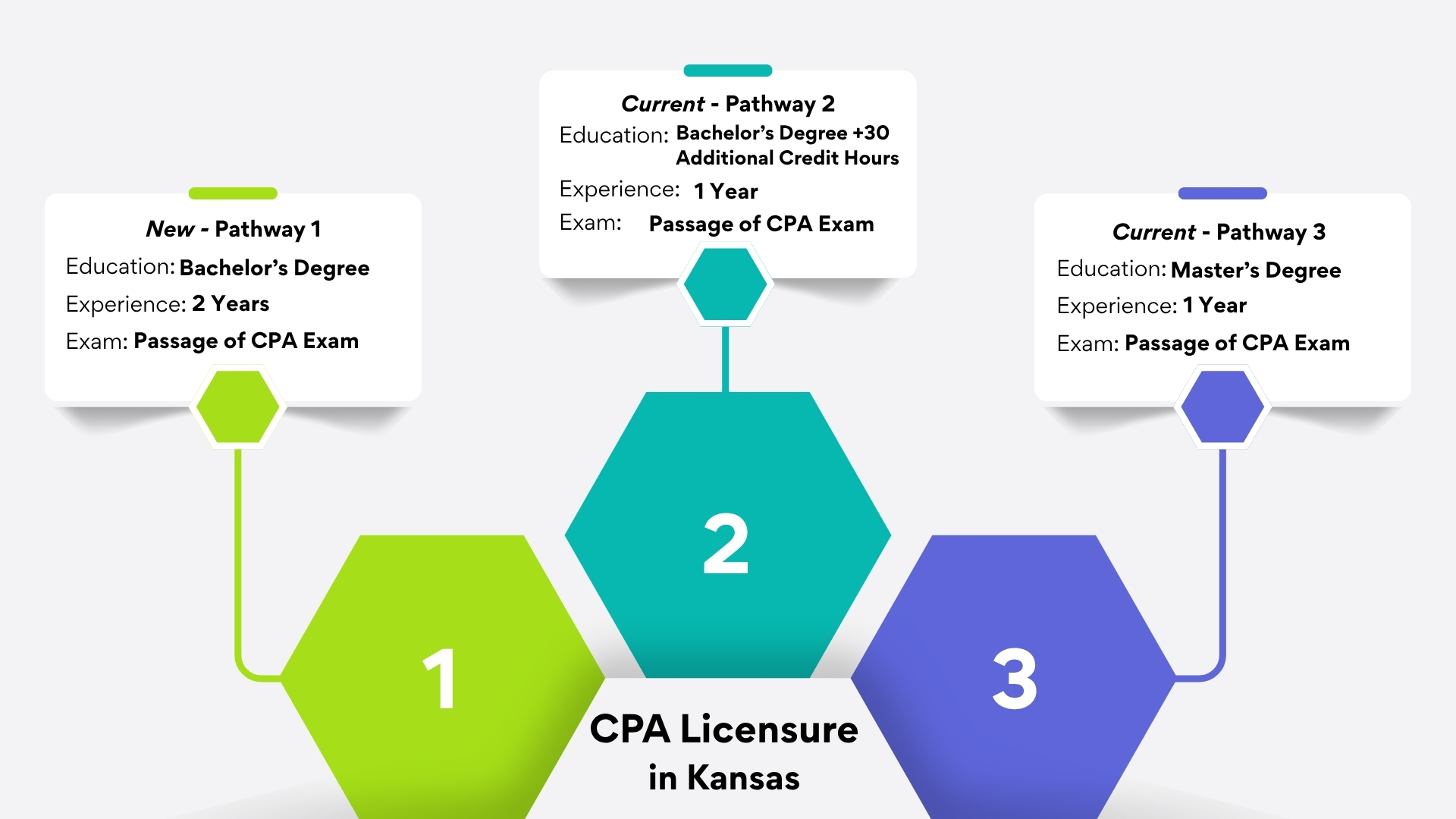
The KSCPA worked with Representative Brian Bergkamp to introduce House Bill 2573, allowing a Bachelor's degree +2 years of experience option in Kansas. The bill passed the House and Senate Unanimously and was signed into law by Governor Laura Kelly on April 9, 2026. The bill goes into effect upon publication in The Kansas Register.
Upon publication the Pathways to CPA licensure in Kansas will be:
The House and Senate passed a budget bill, CCR for HB 2513, appropriating $26 billion for FY 2027 and $10.7 billion from the state general fund. The Governor line-item vetoed more than 30 budget provisions, and the Legislature overrode 12 of them. Key items overridden by the House and Senate include:
Legislators also took action on vetoed bills and conference committee reports that were not passed during regular session. Since the Legislature adjourned Sine Die, they will not have the opportunity to override any vetoes on measures passed during Veto Session. Below are key Veto Overrides and Conference Committee Reports acted upon during Legislative Veto Session.
VETO OVERRIDDEN
Occupational Licensing - Senate Bill 30 requires legislative approval for new occupational licensing requirements or significant changes adopted by state agencies. The new provisions do not apply to the judicial branch or medical professionals. The legislature overrode the veto on a vote of 88-35 in the House and 30-9 in the Senate.
VETO SUSTAINED
In State Tuition Repeal - Senate Bill 254 was vetoed by the Governor. The bill prohibits anyone in the country unlawfully from receiving public benefits, including in-state tuition for undocumented students in Kansas. An override of the veto was not taken up, and the veto was sustained.
VETO OVERRIDDEN
School Choice Tax Credit-The Governor Vetoed Senate Bill 361, which authorizes Kansas to participate in a federal tax credit program that incentivizes individual donations to scholarship-granting organizations, which will expand scholarship opportunities and school choice for low-income students. The veto was overridden on a vote of 85-38 in the House and 29-10 in the Senate.
VETO OVERRIDDEN
Landlord Tenant Leasing- Senate Bill 391 prohibits cities and counties from requiring landlords to accept tenants using housing vouchers or other forms of public assistance, and prevents local governments from restricting a landlord’s ability to consider a tenant’s income source. The veto was overridden by a vote of 31 to 8 in the Senate and 85 to 38 in the House.
VETO OVERRIDDEN
Public Nuisance Claims - Senate Bill 462 reforms the Kansas public nuisance law by limiting certain lawsuits and requiring plaintiffs to show a specific (“special”) injury. The conference committee added language from SB 463 to restrict negligence claims when a person is injured while engaging in wrongful conduct, placing the burden on the defendant to prove that conduct. The veto was overridden on a vote of 30-9 in the Senate and 86 to 37 in the House.
VETO OVERRIDEN
Data Sharing - The Governor vetoed Senate Sub. for HB 2004 requires the Kansas Department for Children and Families (DCF) and the Office of the Inspector General to share information related to public assistance programs to detect and investigate fraud, and mandate that DCF and the Kansas Department of Health and Environment provide relevant state data to federal agencies such as the USDA and HHS. The veto was overridden on a vote of 85-38 in the House and 29-10 in the Senate.
VETO SUSTAINED
Citizenship on Driver’s License - House Bill 2587 requires that citizenship status be listed on driver’s licenses and permits any person whose driver’s license lists such person as a noncitizen to obtain a provisional ballot for voting purposes if the person claims to be a citizen. The Governor vetoed the bill, and an override of the veto was not taken up; the veto was sustained.
VETO OVERRIDEN
Contingency Fees - The Governor vetoed House Bill 2593, which requires political subdivisions to hold an open meeting before approving contingency fee contracts for legal services and to obtain approval from the Attorney General before the contracts take effect. The AG is authorized to review, approve, or deny contracts, report annually on denials, and intervene or seek dismissal in cases of noncompliance. The veto was overridden on a vote of 85-38 in the House and 27-12 in the Senate
VETO OVERRIDDEN
Rules & Regulations-The Governor vetoed House Bill 2719, which makes multiple changes to Kansas’ rules and regulations process to improve efficiency and transparency, including an easier pathway for “technical amendments” to be adopted and the establishment of a priority system for certain regulations to move faster through review. The bill also strengthens legislative oversight by requiring agencies to submit proposed regulations to the Joint Committee on Administrative Rules and Regulations before legislative ratification. The veto was overridden by a vote of 89 to 34 in the House and 38 to 1 in the Senate.
VETO OVERRIDDEN
Benefit Eligibility Recertification - The Governor vetoed House Bill 2731, which would strengthen eligibility verification in public assistance programs by expanding data matching and directing agencies to improve oversight and accuracy in benefit eligibility determinations. The bill also includes a provision requiring the state to seek federal approval to provide continuous Medicaid eligibility for individuals with intellectual or developmental disabilities receiving HCBS waiver services, while clarifying limits on eligibility changes and data use. The veto was overridden by a vote of 87 to 39 in the House and 29 to 10 in the Senate.
Tax Credit Package - CCR for Senate Bill 82 includes tax credits for ethanol-blended fuel, lockable gun and ammunition storage, and removes several unused tax credits. The package also includes changes for the childcare tax credit program to increase participation and utilization, including a three-year carry-forward. The conference committee passed the House on a vote of 76 to 45, and the Senate on a vote of 36 to 2.
Single-Factor Tax for Alcohol Manufacturers - CCR for Senate Bill 300 allows in-state manufacturers of alcoholic liquor to use the single sales factor apportionment method to apportion business income to Kansas for corporation income tax purposes for tax years beginning on or after January 1, 2027. The bill also repeals obsolete global intangible low-taxed income (GILTI) provisions.
Tax Package for Active Duty and SAFESR - CCR for House Bill 2044 enacts a subtraction modification for certain compensation received by active-duty members of the armed forces. The bill also specifies that taxpayers would not lose eligibility for certain residential property tax relief programs due to their residential values increasing above the eligibility threshold, provided they previously received refunds under the programs (SAFESR). The bill passed on a vote of 40-0 in the Senate and 116-4 in the House.
Agritourism - S Sub for House Bill 2111 prohibits a city or county from enforcing any building code, ordinance, or resolution regulating the use of a non-public registered agritourism location, allowing agritourism business provisions to apply to invitation-only businesses. The bill passed the Senate on a vote of 27 to 13 and the House 71 to 49.
Sales Tax Package - CCR for House Bill 2535 extends the local sales tax distribution formula freeze for one additional year for city/county revenue sharing and provides additional sales tax authority for Labette, Butler and Sedgwick counties. The bill will be effective upon publication in the Kansas Register. The Senate passed the bill 30 to 8, but failed to advance in the House when a motion to not adopt the conference committee report passed 107 to 14.
School Recess & Physical Fitness Test - CCR for House Bill 2763 establishes minimum requirements for recess in public schools and includes recess time in school term calculations beginning in the 2027–2028 school year and directs the State Board of Education (State Board) to establish a Kansas State Physical Fitness Test, which will help with an application to the Rural Health Transformation Fund. The bill passed the Senate 29 to 10 and the House 74 to 47.
The Governor still has legislation from the regular session awaiting consideration. Because the Legislature adjourned Sine Die on Saturday, it will not have the opportunity to attempt veto overrides. Issues vetoed will need to be reintroduced during the 2027 Legislative Session, which is set to begin on January 11, 2027.
© Copyright 2026 KSCPA | All Rights Reserved